
Franz Rudolf Bienenfeld and The Religion of the Non-Religious Jews

Guest contribution by Anne Rethmann
Franz Rudolf Bienenfeld (1886–1961) was an Austrian-Jewish legal scholar and lawyer who later became a leading member of the World Jewish Congress in London. In November 1937, only months before Austria’s annexation by Nazi Germany, he delivered before the Society for the Sociology and Anthropology of the Jews a lecture in Vienna titled “The Religion of the Non-Religious Jews”.
In this remarkable text, Bienenfeld explores how the ethical and intellectual legacy of Judaism continued to shape modern secular Jewish identity. He argues that ideas such as justice, reason, and human solidarity constitute a kind of “religion without religion” — the unconscious continuation of Jewish moral thought, shaping both the secular Jew and modernity itself. His vision is not a nostalgic defense of faith but an appeal to preserve moral universality in an age of growing hatred and disintegration.
When Bienenfeld urged Jews to form alliances with non-Jews who shared the same humanistic values, he did not speak as an idealist. His call was a plea for solidarity at a moment when European humanism was collapsing. The lecture thus reads as both cultural diagnosis and moral appeal — a last effort to sustain the ethical foundations of Enlightenment on the eve of their destruction.
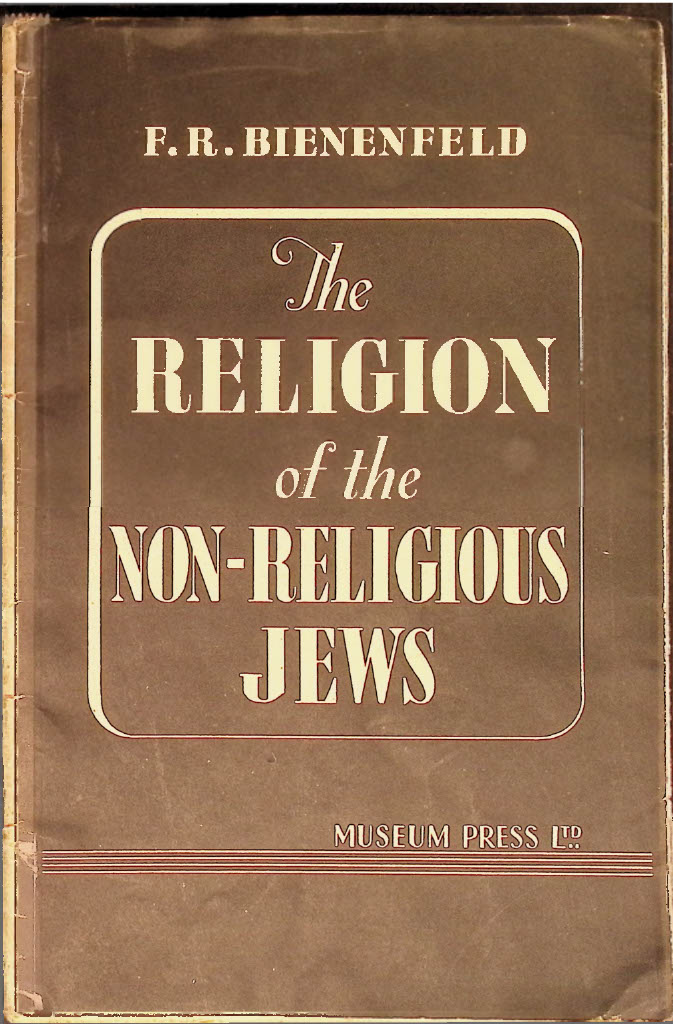
The religion of the non-religious Jews : a lecture delivered to the Sociological Society of Vienna on November 10th, 1937
From exile in London, Bienenfeld revisited the essay in 1944, left it unchanged but added a preface that reframed his earlier hope through the experience of annihilation. By then, the Shoah was widely known, though the Nazi regime had not yet been defeated. Looking back on his 1937 lecture, he realized that humanistic conviction alone had proved powerless against total destruction. The task was not to restore what had been lost but to anchor humanism in law and political institutions — and, if necessary, to defend it by force.
To read Bienenfeld today is to encounter a thinker standing at the threshold between Enlightenment and its ruin. He neither retreats into religious traditionalism nor abandons the belief in reason. Instead, he redefines the Jewish legacy as part of the moral conscience of a shattered Europe — a reminder that what the antisemite marks as a flaw in the Jewish may, in fact, be the very condition of the human. His 1937 lecture already carried the seeds of his later engagement — with Zionism, with human rights, and with the political institutions that would define his work at the World Jewish Congress. What began as a moral and intellectual appeal would transform into a political commitment: from moral reasoning to institutional defense, from humanism as conviction to humanism as law.
Anne Rethmann is a postdoctoral fellow in the Martin Buber Society of Fellows in the Humanities and Social Sciences at the Hebrew University of Jerusalem. Her lecture on Franz R. Bienenfeld was delivered at the Wiener Library on 11 November 2025, as part of the Minerva–Wiener Research Workshop, titled Antisemitism, Racism, Right-Wing Radicalism: How Current Events Inform Historical Understanding, and Vice Versa.
Bienenfeld’s book, The Religion of the Non-Religious Jews, is held in the original Wiener collection and is available online as part of the Wiener Library digitization project. It can be accessed here.