
The Sex Reform Movement in Weimar Republic, Magnus Hirschfeld and the Institute for Sexual Science


Towards the end of the 1910s there was a new general trend in Germany which tended to legitimize homosexuality as a normative social phenomenon and, whilst doing so, also sought its decriminalization. This activity engaged organizations from opposite ends of Weimar politics: on one side the Völkisch, antisemitic League for Human Rights (Bund für Menschenrecht), which grew out of WWI trenches and carried the banner of heroic, chauvinist homosexuality, directed against the prudish morals of Weimar bourgeoisie; on the other was the Scientific-Humanitarian Committee (Wissenschaftlich-humanitӓres Komitee, WhK), under the direction of Magnus Hirschfeld.[1] Whereas the two movements were assisted by biological research to deny the conception of homosexuality as pathology or perversion, the WhK alone aspired to exhaust the scientific trend; that is since according to Hirschfeld (1868-1935) only the rediscovery of homosexuality as a biological anomaly should bring about substantive political progress. This mindset of Hirschfeld was embodied in his personal motto “per scientiam ad justitiam”: justice by science. The scientific trend was supposed, therefore, to have significant consequences: not only to strip away the moralistic stances assailing homosexuality but also prove such prejudices as perpetuating historical injustice.[2]
The sex reform movement in Germany originated in the Second Reich, where penalization of homosexual intercourse was enacted through paragraph 175 of the criminal code (1871). In close connection with the increase of political progress it achieved was the rising recognition of homosexuality in biology, social sciences and psychiatry, as in the research of Richard von Krafft-Ebing.[3] According to the prevailing stance among the advocates of sexual reform in German academia and public discourse in this period, homosexuality was an incurable physical disease and therefore, despite a regrettable moral disorder, ought not to be subject to legal sanctions. The momentum enjoyed by the reform movement throughout the Weimar period was also very much due to the scientific trend, which now enabled the determination of a new purpose for its political struggle: not merely the decriminalization of homosexuality on humanitarian grounds, but also the repudiation of its pathological status. The scientific contribution of Hirschfeld, a trained physician, encompassed two hundred publications in this regard. His key study of the subject was Die Homosexualität des Mannes und des Weibes (“The Homosexuality of Men and Women”) from 1914. In his early research Hirschfeld maintained that homosexuality constitutes a third sex, interposed between masculinity and femininity.[4] Moreover, he attempted to form a physical model for the third sex, and unexpectedly had not abandoned this eccentric effort until very late, when the Nazis dismantled his life project.[5]
Hirschfeld founded and led many civil society organizations, among them the Scientific-Humanitarian Committee, the avant-garde of the sexual reform movement. In 1919 he established in Berlin the Institute for Sexual Science (Institut für Sexualwissenschaft), whose stated aim was twofold: “scientific research on all of human sexuality and love life, as well as the sexual life of all other creatures… and to make use of this research for all”.[6] Thus, the institute assisted in translating its achievements in research into political and medical practices: one department was assigned to the task of sexual reform and, in collaboration with the WhK, helped in carrying out various highly significant research projects. The institution also organized conferences and training sessions in its field, and at the same time became a meeting center for homosexuals from all over Germany. In particular, these special training programs were attended by members of the Medical Society for Sexual Science and Eugenics (Ärztliche Gesellschaft für Sexualwissenschaft und Eugenik), founded by Hirschfeld. The same programs were intended to compensate for the absence of homosexuality from the curricula of medical schools.[7]

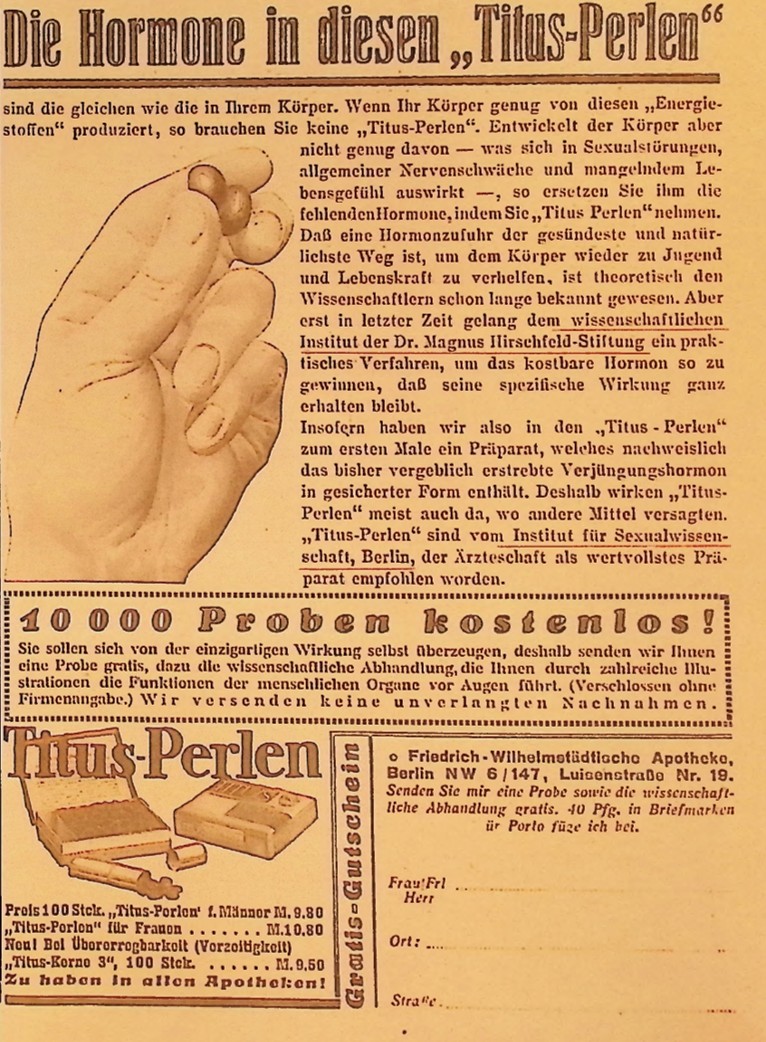
Advertisements for “Titus-Perlen”, Münchner Illustrierte Presse 9, no. 11 (13 March 1932): 261; no. 30 (2 October 1932): 1105
Advertisements for the hormonal product Titus-Perlen ("Titus Pearls") appeared in the Münchner Illustrierte Presse in 1932. Promising to increase sexual desire, improve sexual performance, and restore vitality, the advertisements invoked the scientific authority of Magnus Hirschfeld’s Institute for Sexology, which was said to have developed and tested the product. As early as 1933, however, the manufacturer stopped using Hirschfeld’s name and that of the Institute, replacing sexological science with the exotic appeal of traditional Chinese medicine.
From the outset the movement ascribed the revocation of paragraph 175 as its most important objective, a provision whose repeal Hirschfeld had famously petitioned for already in 1898. In the period preceding the collapse of the Second Reich and towards the formulation of Weimar constitution, the reform movement found a proper season to pursue its revolutionary task. The reformers placed their hopes in the Social-Democratic Party (SPD) once it came to power, since many of its members, including its former leader, the late August Bebel, were loyal sympathizers with the reform movement from its early days.[8]
Several years after the Weimar Constitution entered into force, the SPD minister of Justice Gustav Radbruch drafted a new criminal code in which paragraph 175 was significantly mitigated. Nevertheless, this version was revised several times, resulting in the 1925 draft penal code, which remained largely identical to its predecessor regarding the legal treatment of homosexuality. Following this failure, the distinct reform movements, including the WhK, reorganized as the Cartel for the Reform of the Sexual Penal Code (Kartell zur Reform des Sexualstrafrechts).[9] Alongside homosexual emancipation, the Cartel demanded the full equality of women’s rights, the liberalization of matrimonial law, the legalization of abortions and birth control, and the removal of legal discrimination against illegitimate children; however, it accomplished little success in the field of legal reform.[10] The greatest advancement in that regard was achieved through the formulation of a counter-draft by the Cartel. In this draft, the juridical argument in support of homosexual emancipation invoked “innate constitution” (angeborenen Konstitution); that is, for the first time concerning homosexual acts, biology superseded religious morality as a legislative rationale. The new initiative yielded positive outcomes in the 1929 Reichstag Committee on Criminal Law, when the provisions criminalizing homosexual acts were struck from the draft; yet, as eventually no final draft by the Committee was voted upon in the Reichstag, paragraph 175 remained unchanged.[11]
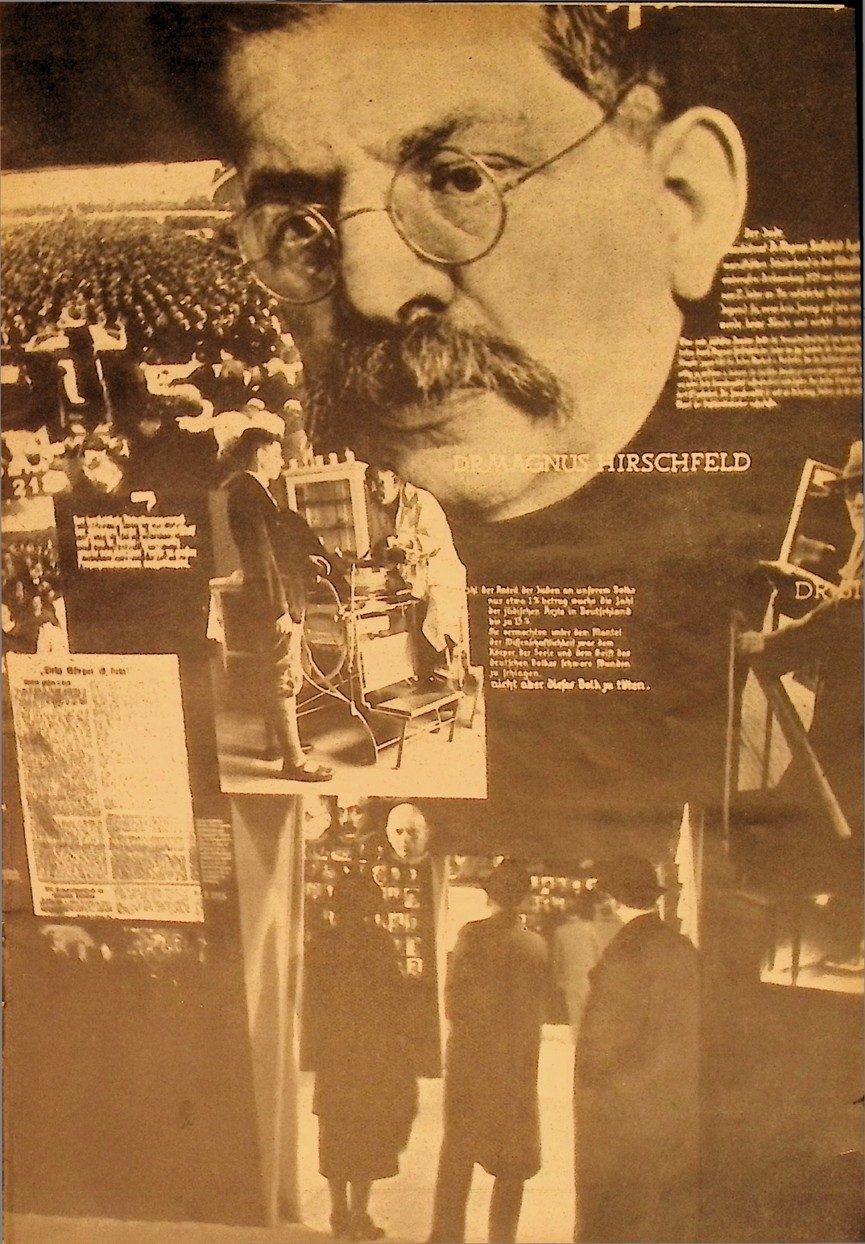
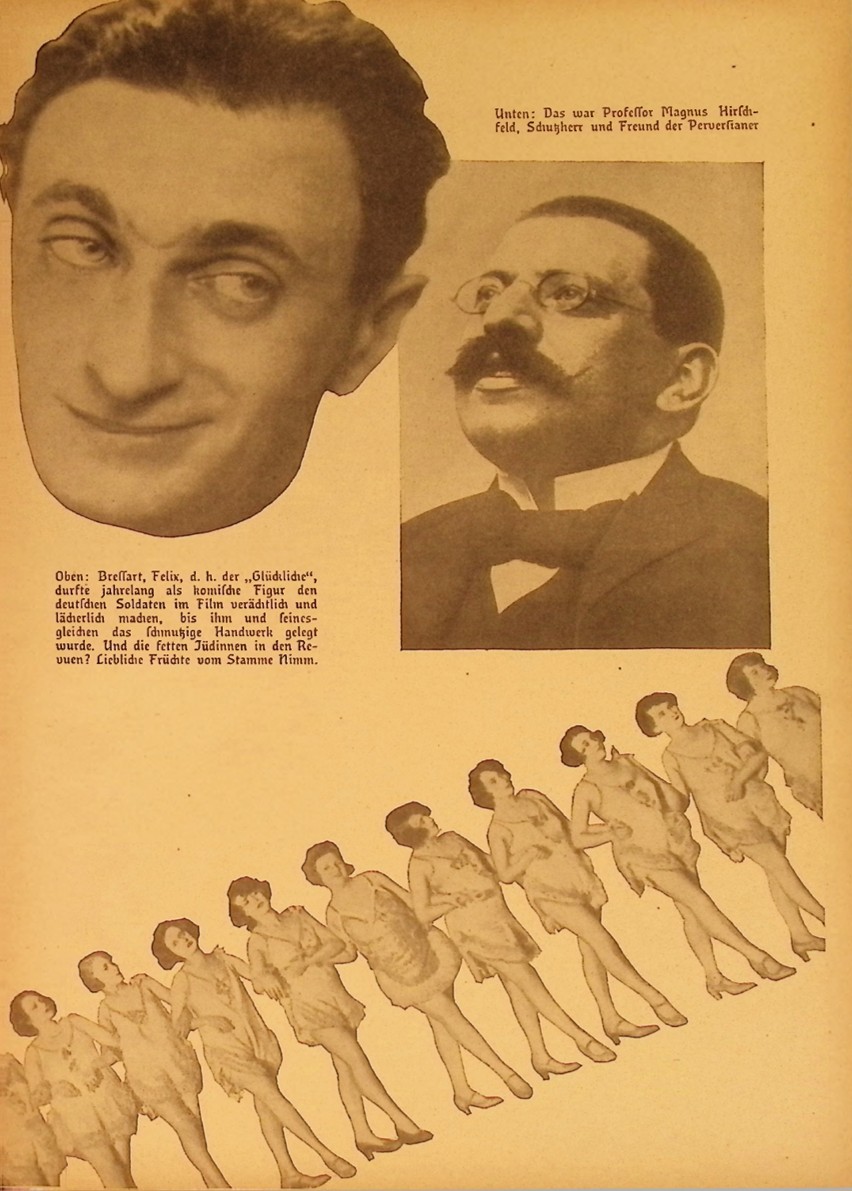
Neues Folk, Heft 1, Januar 1938, 6 Jahrgang; Heft 2, Februar 1939, 7 Jahrgang.
Images of Magnus Hirschfeld appeared repeatedly in feature articles published in Neues Volk, the official magazine of the NSDAP Office of Racial Policy. The articles presented him as part of an alleged Jewish campaign to promote racial mixing and sexual "degeneracy."
The persecution of homosexuals was not on the agenda of the Nazi movement at its origin, since the Nazis regarded gender issues – to use the current terminology – only secondary to the foremost problem of race. Their treatment of the subject was largely opportunistic, as they occasionally used opposition to sexual progress to vilify what they saw as Jewish subversion. In a 1927 speech by the Nazi Reichstag deputy Wilhelm Frick, he accused Hirschfeld and his colleagues of a systematic attempt to abuse the German Volk.[12] There was nothing new in such an argument; the homophobic slander of moral corruption had already been associated with antisemitic stances even before the emergence of the sexual reform movement. In any case, it was not until their seizure of power and the Night of the Long Knives in June 1934, that the Nazis took advantage of the conservative moment in the early Third Reich and turned reactionary politics into official state ideology.
Similarly to the Berlin Psychoanalytic Institute, the Institute for Sexual Science did not endure long after the Nazis’ assumption of power. Already in May 1933 its laboratories and libraries were plundered and their inventories incinerated in the infamous book burning in Bebelplatz. Finally, within several months, the activity of the Institute had been terminated, and the path was likewise barred for any further work by the Scientific-Humanitarian Committee and the Cartel for the Reform of the Sexual Penal Code. The political upheavals in Germany led also to the cessation of activity by the sexual reform movement throughout Europe. In 1928, following a successful series of international congresses hosted by the Institute, the coordinating authority of the “World League for Sexual Reform” was founded. Since its establishment, the League had been securely based in Berlin, from where it conducted its pan-European campaign for family reform. After the Nazis’ takeover, there had been attempts to displace the center of activity to Paris; but these were nonetheless futile, and following the exile of Hirschfeld and his death in 1935, the League’s remaining presidents brought its operation to an end.[13]
Bibliography
Baumgardt, Manfred. “Das Institut für Sexualwissenschaft und die Homosexuellenbewegung in der Weimarer Republik.” In Eldorado: Homosexuelle Frauen und Männer in Berlin 1850–1950. Geschichte, Alltag und Kultur, edited by Michael Bollé and Berlin Museum, 31–41. Berlin: Frölich & Kaufmann, 1984.
Marhoefer, Laurie. Sex and the Weimar Republic: German Homosexual Emancipation and the Rise of the Nazis. Toronto: University of Toronto Press, 2016.
Neumann, Boaz, New Histories of Nazism, Modan Publishing House, 2019.
Plant, Richard. The Pink Triangle: The Nazi War Against Homosexuals. 1st ed. New York: Henry Holt & Company, 1988.
[1] Boaz Neumann, New Histories of Nazism (Modan Publishing House, 2019), p. 100.
[2] Laurie Marhoefer: Sex and the Weimar Republic: German Homosexual Emancipation and the Rise of the Nazis, (University of Toronto Press, 2016), pp. 4-19.
[3] Richard Plant, The Pink Triangle: The Nazi War Against Homosexuals. 1st ed. (Henry Holt & Company, 1988) p. 32.
[4] Ibid, p. 30.
[5] Ibid, p. 34.
[6] Sex and the Weimar Republic p. 4. From a speech given by Hirschfeld on the opening evening, July 1st 1919.
[7] Manfred Baumgardt, “Das Institut für sexualwissenschaft und die Homosexuellenbewegung in der Weimarer Republic.“ In: Eldorado, Homosexuelle Frauen und Manner in Berlin 1850-1950 (Frolich & Kaufmann, 1984), pp. 31-32.
[8] Ibid.
[9] Ibid, 34.
[10] Ibid, 35.
[11] Ibid.
[12] Ibid, 36.
[13] Ibid, p. 34.