
Holocaust Remembrance Day 2026


Since the publication of the complete edition of his Tagebücher in 1995, Victor Klemperer has turned into one of the most frequently cited sources in the study of the Holocaust and the Nazi era in Germany and beyond. How so? In his diaries one can find a penetrating insight into the collapse of German society, within which he lived and to which he belonged throughout his life, including the dire years of the Third Reich. Nevertheless, the linguistic investigation that he conducted in these diaries, which were later published as "LTI – Lingua Tertii Imperii – Notizbuch eines Philologen" (1947; The Language of the Third Reich: A Philologist’s Notebook), provides a valuable key for understanding the Holocaust and the Nazi phenomenon even beyond his immediate context. Its value lies not necessarily in offering a comprehensive description of the tendencies of the Nazi official speech, but rather in that its method of inquiry corresponds to the deep structure of this language in its many forms. Klemperer's case reasserts the historiographic absurd of the Third Reich: It is not the cold, distant and retrospective "view from nowhere", but rather the documents written in the very time and place themselves, above all the personal testimonies, that have produced the most precise analyses of the Holocaust and Nazism and have yielded conclusions that have proven particularly enduring.[1]
Klemperer was born in 1881 in Landsberg, Prussia, the son of Dr. Wilhelm Klemperer, who served as a rabbi in the local Orthodox community and in Bromberg, and whose modern approach resulted in his dismissal from offices and led him to serve in the Reform community in Berlin, a highly assimilated circle whose practices were shaped by liberal Protestant spirituality. The seven children of the Klemperers were baptized into Protestant Christianity in adulthood. At the age of 19 Victor turned to studies at the University of Munich, where he was trained in philosophy and philology of German and the Romance languages, and finally specialized in the French literature of the Enlightenment. He later completed his dissertation on Montesquieu, receiving his doctorate. In 1906 he married Eva Schlemmer, a pianist and music teacher, and a non-Jew. At the outbreak of the First World War Klemperer, a professed German patriot, volunteered for the Bavarian army and was deployed as an artilleryman on the Belgian front for several months. After the war he was appointed professor of Romance languages at the Technical University of Dresden.[2]
Their long and stable period in Dresden, years of scholarly productivity for Klemperer, was interrupted with the Nazis' assumption of power. The implementation of "The Law for the Restoration of the Professional Civil Service", which led to the mass dismissal of Jewish civil servants, together with the boycott of Jewish businesses and professionals in April 1933, did not initially affect Klemperer, owing to an exemption permitting WWI veterans to retain their positions.[3] However, in May 1935 the ordinance was cancelled.[4] Under this law and "The Law for the Protection of German Blood and Honour" from the Nuremberg laws, he was stripped of his academic title, his office, and his civil rights, and was eventually forced into manual labor in a factory.[5] From that year onwards he kept a diary documenting everyday life under the regime which deprived him of his freedom and dignity. He was spared deportation, however, by virtue of his marriage, since the regime hesitated to abolish the remaining rights of Jews in so-called mixed marriages. Nevertheless, in May 1940 the Klemperers had to abandon their house in Dölzschen and relocate to one of the Judenhäuser (Jewish Houses) in Dresden.[6] Such housing arrangements brought the height of the process by which German Jews were concentrated and excluded from the public sphere. Yet due to surveillance requirements and apparently also to the Nazi distrust in modern urban forms, they were designed in manners that distinguished them from the Ghettos of Eastern Europe: the Judenhäuser were generally located within all-German neighborhoods, freedom of movement outside of them was limitedly preserved, and non-Jewish forced-laborers were also housed in them.[7] There and in two similar dwellings, they spent the remaining war years, until the allied bombing of the city in February 1945.
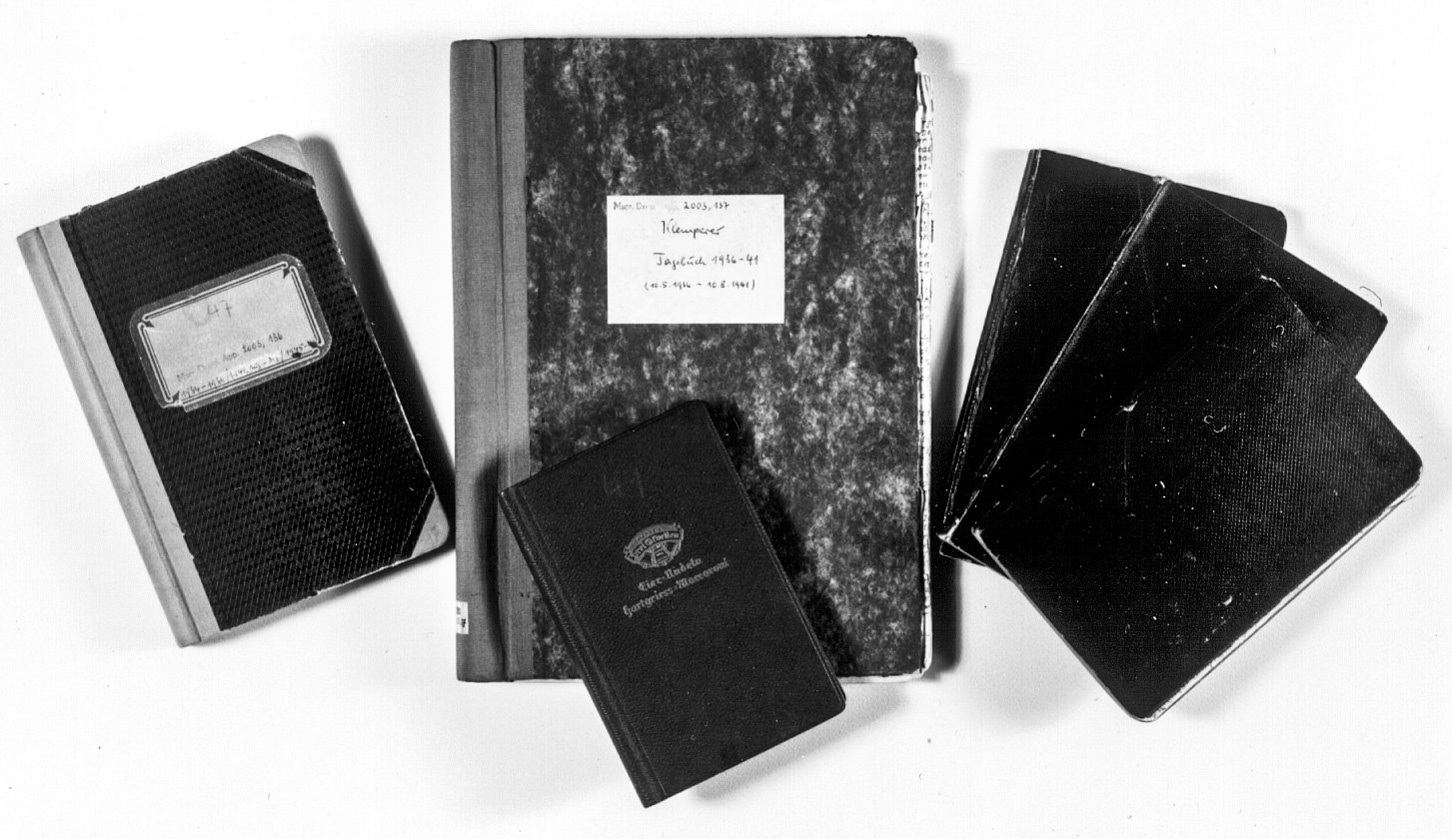
Presentation of some diaries by Victor Klemperer, 1933-1945. Photo: Regine Richter.
Language is modest and elusive, and is only rarely granted a decisive role in fateful historical developments; yet Klemperer succeeded in giving it its due, especially in its everyday forms. As a philologist of Enlightenment literature, and a member of an intellectual elite trained to warn against the collapse of social order, Klemperer was endowed with a sensitivity to oppressive politics, above all the coercive ideology that permeates the deepest layers of meaning and expression. Klemperer drew out details from conversations with Jews and non-Jews alike and recognized the role of each word, however negligible or trivial it might seem, in the fundamental patterns of totalitarian socialization. Indeed, in a broader sense, it was the loss of proportion between the particular and the general that, in his view, was so illustrative of the disintegration of normative society into a dull, antisemitic and opportunistic mass. In this way, from within his own time and place, he drew conclusions that only in the post-war period would be taken up by the pioneering intellectual struggle to come to terms with totalitarianism.
Klemperer located the seed of 20th-century revolutionary movement and state in the reevaluation of fanaticism by Rousseau, unlike the philosophers of his own time, and thus linked it with the bourgeois French Revolution.[8] He depicted the ecstatic dynamism of the new language that replaces words with images and runes and generates neologisms with great momentum. Thus, he was able to connect Nazi ethos with avant-garde artistic movements and helped decipher the "Armed Bohemian" figure.[9] He analyzed organic terminologies as opposed to mechanistic ones in the Nazi tongue, showing how both alike betray its speakers and enslave them.[10] Finally, he demonstrated how the overwriting of German lexicon led, for example, to the rehabilitation of pejorative words as positive political terms, thereby contributing to an insight regarding the irrationality and misanthropy of the regime.[11] He went on to advance one innovative theme after another.
On February 13, 1945, the evening of the fatal allied bombing on Dresden, the Gestapo had gathered the remainder of the Jews in the city, who were gathered in the Jewish houses, yet to be sent into the concentration and forced labor camps.[12] Taking advantage of the turmoil, the Klemperers set out, under false identities, on a journey to Bavaria, where American forces were advancing.[13] The travel's hardships, as Germany approached "Stunde Null", did not deter Victor from his intellectual work. He used the opportunity to interview the many people they encountered and to test his theses, seeking to avoid the scattering of unexamined dogmas. Indeed, until then he relied on nothing but the testimonies of Dresdeners; now he received what is to be taken as the ultimate confirmation of his study’s validity, as he realized that he had nothing to revise in the text beyond minor additions and corroborations: anyone in Germany now spoke the same LTI.[14]
As the war ended, the couple returned safely from their refuge in Bavaria and settled once again in their former home.[15] They became citizens of East Germany. Klemperer was appointed to high positions in prestigious universities, joined the Communist party and served as a member of the Culture Bureau and in the Academy of Sciences of East Germany. Eva Klemperer died in July 1951. Victor continued to serve in his academic and political roles until his death in February 1960, at the age of 78.[16]
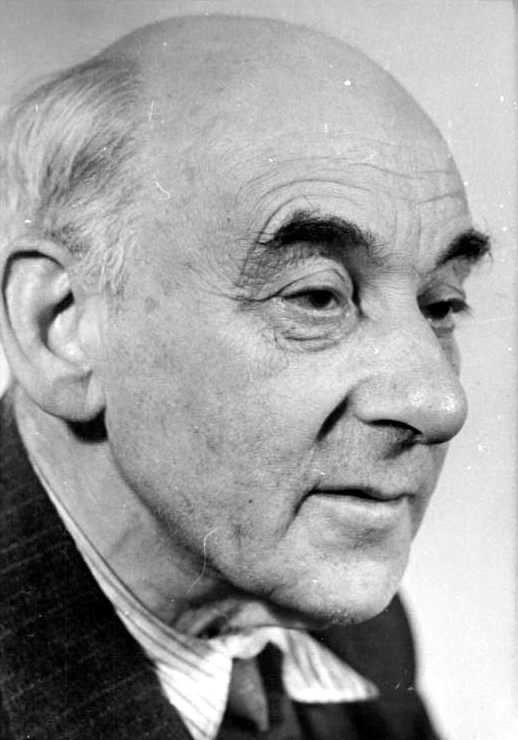
Portrait of Victor Klemperer, 1949. Photo: Eva Kemlein. Bundesarchiv, Bild 183-S90733 (CC BY-SA 3.0).
"A language that thinks and writes for you" – borrowing this remark from Schiller, Klemperer describes a language that had turned the tables on its users: instead of serving reason as a reliable scalpel for analyzing reality, it had become a semi-autonomous means of censorship that functions as an instrument for public surveillance by the oppression of political imagination.[17] His analyses emphasize above all the loss of control, the dissociative character and the madness that seized the speakers of this tongue, until it rendered them totally incompetent, good-for-nothing individuals. Yet his study reverses this tendency: it was able to overcome language that thinks and operates on behalf of its users. In his analytic obstinacy, driven by the resolve to avenge his honor, he subjected it to rational scrutiny and removed the paralyzing and distorting functions that had been imposed on it. With the speaker’s renewed dominion over speech in LTI, the disrupted balance between the individual and the public sphere was restored. The concern for such a balance expresses Klemperer’s faithfulness to the humanist tradition, to which he saw himself committed.[18]
Bibliography:
Arendt, Hannah. The Origins of Totalitarianism. Translated by Idit Zertal. Tel Aviv: Hakibbutz Hameuchad, 2010. [Hebrew].
Heiden, Konrad. Hitler: A Biography. Translated by Winifred Ray. London: Constable & Co., 1936.
Klemperer, Victor. Diaries, 1933–1945: Selections. Translated from German by Tali Kuns. Tel Aviv: Am Oved, 2004. [Hebrew].
———. The Language of the Third Reich: LTI: Lingua Tertii Imperii: A Philologist’s Notebook. Translated by Martin Brady. London and New York: Continuum, 2000.
Talmon, J. L. The Origins of Totalitarian Democracy. London: Secker & Warburg, 1952.
[1] Hannah Arendt, The Origins of Totalitarianism, trans. Idit Zertal (Tel Aviv: Hakibbutz Hameuchad, 2010), p. 459.
[2] Victor Klemperer, Diaries, 1933–1945: Selections, trans. Tali Kuns (Tel Aviv: Am Oved, 2004), pp. 10-11.
[3] Ibid, p. 36.
[4] Ibid, p. 113.
[5] Ibid, p. 120.
[6] Ibid, p. 225.
[7] Diaries, p. 459.
Victor Klemperer, The Language of the Third Reich: LTI: Lingua Tertii Imperii: A Philologist’s Notebook (trans. Martin Brady, London and New York: Continuum, 2000) , p. 157.
[8] LTI, pp. 52-53, 130-131. See also Talmon, The Origins of Totalitarian Democracy (London: Secker & Warburg), 1952) p. 1. Klemperer (Diaries, p. 153) aspired to develop a theory of the so-called languages of the three revolutions (the French, Fascist Italian, and Nazi German) in a single work.
[9] LTI, pp. 63-65, 78-81, 209-211.See also. Heiden, Hitler – A Biography, (Constable & Co.: London, 1936), pp, 53, 266-7.
[10] LTI, pp. 91-96, 138-147.
[11] Ibid, pp. 42-51.
[12] Ibid, p. 241. Diaries, p. 456.
[13] Ibid, p. 467 ff.
[14] LTI, pp. 241-242
[15] Diaries, p. 528.
[16] Ibid, p. 12.
[17] LTI, pp. 14, 55.
[18] Diaries, p. 183.