
Ilse Weber and Theresienstadt - International Women's Day 2026


Ilse Weber (née Herlinger) was born on January 3, 1903, in Vítkovice (German: Witkovitz), a district of Ostrava (Mährisch-Ostrau). Already in her younger years she displayed poetic talent and passion for artistic self-expression: she learned to play guitar, mandolin, lute and balalaika, and, having been educated in German in addition to her native Czech, she began publishing original poetry and prose, mainly children’s stories, in both languages by the age of 13. The first volume to be issued from among her writings was Jüdische Kindermärchen – a collection of Jewish folk tales for children (1928). This was followed by Die Geschichten um Mendel Rosenbusch (“The Stories of Mendel Rosenbusch”, 1929), and Das Trittroller-Wettrennen (“The Scooter Race”, 1935).[1]
At the age of 27 she married Wilhelm (Willi) Weber. The couple settled in Prague, where Ilse now wrote for children’s periodicals and became a producer for the Czech radio. They had two children: Hanuš and Tomáš. Foreseeing the imminent disaster, they managed to send their elder son to family friends in London, and later to Sweden, where he survived the war period. Almost three years after the German occupation of Czechoslovakia, on 6 February 1942, Ilse, Willi and their younger son were deported to the Theresienstadt ghetto in Terezín.[2]
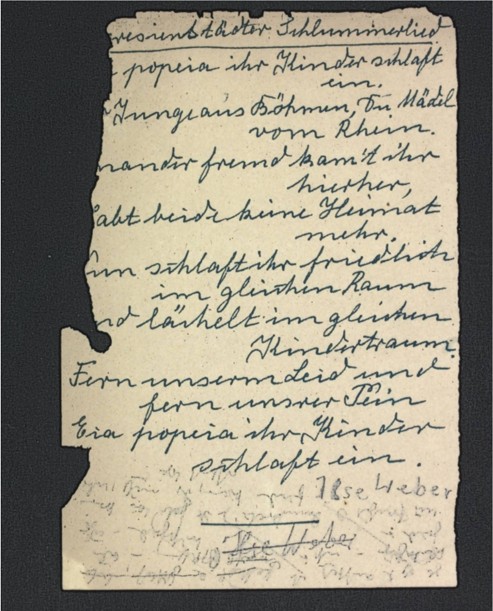
Handwritten poem by Ilse Weber, Wiener Archive collection, Alfred Wiener Documents, Correspondence, poems, etc. from Theresienstadt and other camps, 586.
In September 1941, following the directive of the “Final Solution” and shortly before the ban on Jewish immigration from the Reich and the beginning of systematic extermination, the ghetto of Theresienstadt was reorganized, under the direction of the SS Reich Security Main Office (RSHA), as the deportation centre for the Jews of the Protectorate of Bohemia and Moravia. From the outset the site also functioned as a detention camp for privileged groups among German Jews, whose nationality status the Nazi jurists found difficult to abolish: decorated WWI veterans and prominent individuals, so-called Mischlinge (persons of mixed Jewish ancestry under the Nuremburg laws) and Jews in mixed marriages. Additionally, Theresienstadt was represented to the Jewish state nationals over the age of 65 as a retirement settlement for the elderly, where places could be obtained through the purchase of leases in exchange for all the deportees’ property. The detainees in Theresienstadt suffered malnutrition, poor treatment and disease. From 1942 the ghetto functioned as a transit camp to Auschwitz, to which most of its permanent residents were eventually deported.[3]
The image of Theresienstadt as a retirement community, as also pictured in the staged propaganda film produced therein and during the visit of International Committee of the Red Cross in April 1945, was characteristic of the Nazi regime’s systematic use of euphemistic language. The function of lingual sanitization was to obscure the meaning of the deplorable acts executed by this regime towards various populations, including the elimination of rights, concentration and extermination. Through technical definitions and objective description of administrative tasks, the Nazi perpetrators could operate their mechanism of destruction almost under the guise and impression of humble anonymity. Influenced by the Nazi speech, euphemistic forms of expression came to be adopted by the victims themselves, in order to mitigate their dreadful experience of helplessness in the face of uncertain future.[4]
Upon her arrival in Theresienstadt, Weber volunteered to work in the children’s infirmary, at first as a night nurse and later as head nurse. During her imprisonment she wrote dozens of poems describing daily life in the camp and the plight of the inmates, including children’s songs and lullabies, which she composed and sang, accompanied by her guitar, to the children in her care. Her poems, intended to protect their listeners from the bitter reality, yet necessarily also pointing toward it, thus reflect the consciousness of the inhabitants of the “model ghetto”. A central motif in them is the sleeping prisoner, whose imagination wanders into realms of visual and musical fantasy; yet the incomprehensible catastrophe closes in on him from every side. [5]
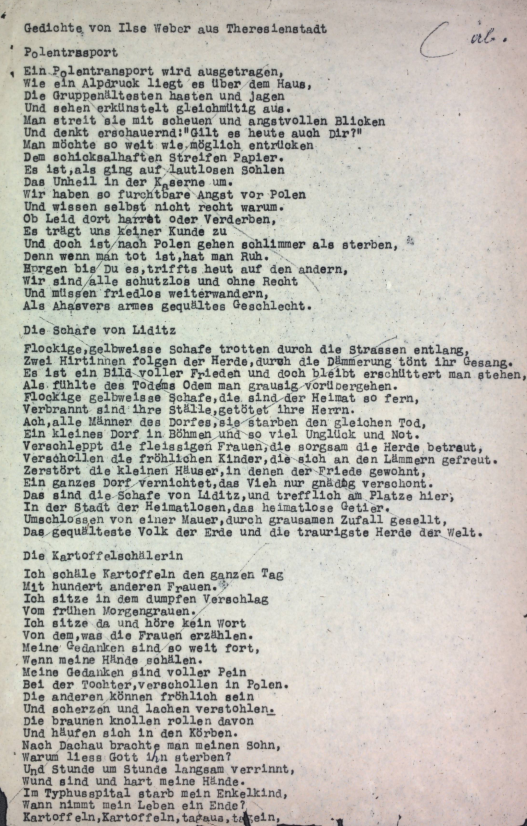
Page from Ilse Weber, Gedichte von Ilse Weber aus Theresienstadt, 1942, containing three poems including “Die Schafe von Liditz.” Wiener Archive collection, Alfred Wiener Documents, Correspondence, poems, etc. from Theresienstadt and other camps, 586.
Die Schafe von Liditz
Flockige, gelbweiße Schafe trotten durch die Straßen entlang,
Zwei Hirtinnen folgen der Herde, durch die Dämmerung tönt ihr Gesang.
Es ist ein Bild voller Frieden und doch bleibt erschüttert man stehen,
Als fühlte des Todes Odem man grausig vorübergehen.
Das sind die Schafe von Liditz, und trefflich am Platze hier,
In der Stadt der Heimatlosen, das heimatlose Getier.
Umschlossen von einer Mauer, durch grausamen Zufall gesellt,
Das gequälteste Volk der Erde und die traurigste Herde der Welt.
The Sheep from Liditz
Fluffy, yellow-white sheep trot along the streets.
Two herds are walking them, their song rings through the twilight.
This is a peaceful vision, and yet one stands shaken,
As if the breath of death passed gruesomely by.
These are the sheep from Liditz, whose place here is so fitting,
In the city of the homeless, for the homeless creatures.
Trapped behind those walls, cruel coincidence had gathered
The sorest folk on earth and the world’s sorriest herd.
In September 1944 Willi was among some five thousand other forced-labour workers deported on a transport ostensibly to Dresden, but in fact bound for Auschwitz. There, in the Gleiwitz sub-camp, he survived until the area was liberated. As he later learned from testimony, when Ilse realized that the children in her care were destined for deportation, she refused to be separated from them and accompanied them on the transport to Auschwitz with her younger son, where she may also have hoped to reunite her family. Ilse and Tomáš were murdered upon arrival at Auschwitz, on 6 October 1944.
After the liberation of the camp Willi traveled back to Theresienstadt and retrieved his wife’s treasured manuscripts. The first volume to publish her lyric poems, alongside writings by other Terezín inmates, was the Terezín Album issued by the Cultural Association of the ČSSR. In Israel, the pieces came into the hands of her close circle of friends, who jointly published a first German edition of her Theresienstadt poems in 1964.[6] Willi Weber passed away on 6 August 1974. The first English collection of Ilse’s poems was published in 1991. Especially in the last twenty years, her poems have been widely studied, translated, and performed.[7]
The Wiener Archive holds manuscripts and typescripts of Ilse Weber's poems from Theresienstadt, along with poems and correspondence written by other inmates in the camp.
Bibliography
Holocaust Music Archive. Theresienstadt – Ilse Weber. Accessed February 24, 2026. https://holocaustmusic.ort.org/places/theresienstadt/ilse-weber/.
Neuman, Boaz. Re’iyat Ha-olam Ha-natzi: Merhav, Guf, Safa [The Nazi Worldview: Space, Body, Language]. Haifa and Tel Aviv: University of Haifa Press / Sifriat Ma’ariv, 2002.
Weber, Ilse. Gedichte von Ilse Weber aus Theresienstadt [Poems from Theresienstadt]. 1942. Wiener Archive collection, Alfred Wiener Documents, Correspondence, poems, etc. from Theresienstadt and other camps, 586.
Weber-Herlinger, Ilse. Theresienstadt, Gedichte, Handgeschrieben von Berta Kraus-rosen, Mafil Ltd., Tel Aviv 1964 ; 115 p. mit einem Vorwort von Rudolf Iltis (1958).
Zdeněk, Lederer. Ghetto Theresienstadt. London: Edward Goldston, 1953.
[1] Rudolf Iltis, “Vorwort” (1958), in Ilse Weber-Herlinger, Theresienstadt: Gedichte, handwritten by Berta Kraus-Rosen (Tel Aviv: Mafil Ltd., 1964).
[2] Holocaust Music, “Ilse Weber,” Holocaust Music, accessed March 9, 2026, https://holocaustmusic.ort.org/places/theresienstadt/ilse-weber/.
[3] Zdeněk Lederer, Ghetto Theresienstadt (London: Edward Goldston, 1953), 12–13, 39–40, 49–50.
[4] Boaz Neuman, Re’iyat Ha-olam Ha-natzi: Merhav, Guf, Safa [The Nazi Worldview: Space, Body, Language] (Haifa and Tel Aviv: University of Haifa Press / Sifriat Ma’ariv, 2002), 255–277.
[5] Ilse Weber, “Die Schafe von Liditz,” in Gedichte von Ilse Weber aus Theresienstadt, 1942, Wiener Archive collection, Alfred Wiener Documents, Correspondence, poems, etc. from Theresienstadt and other camps, 586.
[6] Rudolf Iltis, “Vorwort” in Weber-Herlinger, Theresienstadt: Gedichte.
[7] Holocaust Music (ORT), “Ilse Weber.”